
The Second Commandment stands as one of the most profound and challenging directives in the Decalogue. It moves beyond action into the realm of thought, worship, and the very nature of our relationship with the Divine. Its words have sparked theological debate for millennia:
“You shall not make for yourself an image in the form of anything in heaven above or on the earth beneath or in the waters below. You shall not bow down to them or worship them; for I, the Lord your God, am a jealous God, punishing the children for the sin of the parents to the third and fourth generation of those who hate me, but showing love to a thousand generations of those who love me and keep my commandments.” (Exodus 20:4-6)
While traditionally interpreted as a prohibition against physical idols, modern spiritual thinkers like Abd-ru-shin (the pen name of Oskar Ernst Bernhardt, 1875-1941) have expanded its meaning into a critical examination of all forms of spiritual limitation. His work in In the Light of Truth: The Grail Message offers a radical lens through which to view this ancient law.
The Surface Prohibition: Rejecting Physical Idols
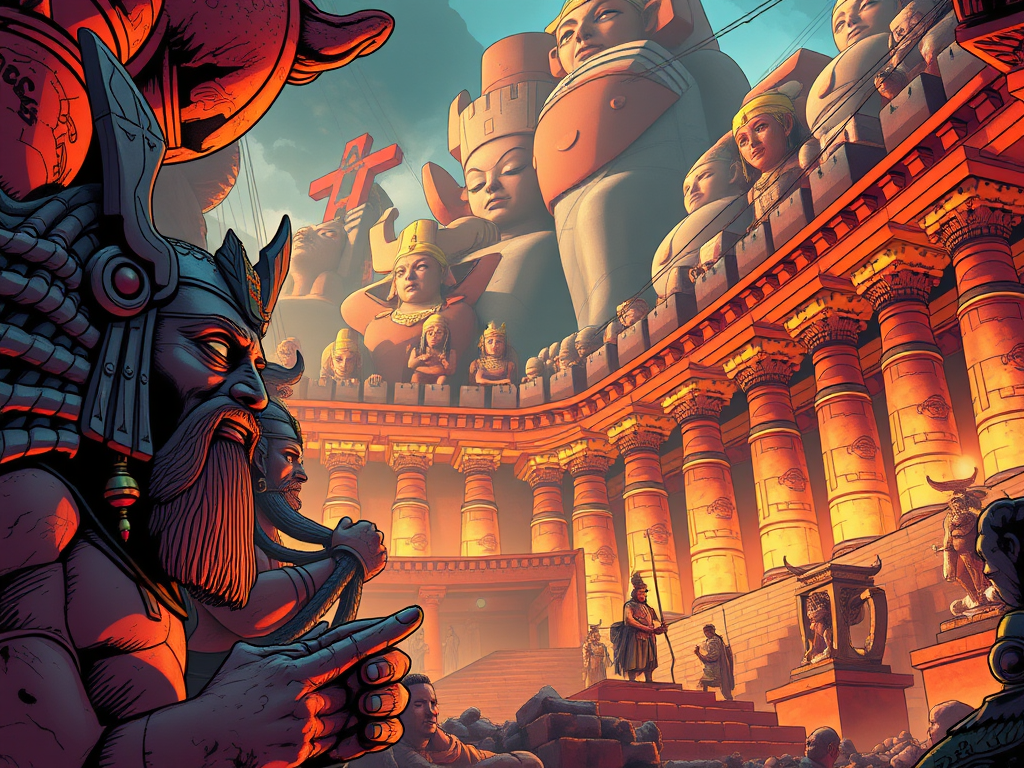
On its most basic level, the commandment is clear: do not create physical representations of God to worship. In the context of the ancient world, saturated with polytheistic idolatry, this was a revolutionary concept. It established a fundamental difference between the God of Israel—formless, omnipresent, and transcendent—and the man-made, limited gods of neighboring cultures.
This prohibition safeguarded the purity of worship, ensuring it was directed toward an unfathomable Spirit rather than a tangible object that could be controlled, manipulated, or reduced to human specifications.
Abd-ru-shin’s Deeper Critique: The Idols of the Mind
Abd-ru-shin acknowledges this surface meaning but argues that humanity’s error runs much deeper. For him, the real danger isn’t just carved statues but the internal, intellectual idols we create.
He contends that humanity has consistently failed this commandment by constructing mental images of God, rigid dogmas, and limiting doctrines that serve the same purpose as a golden calf: they make the incomprehensible seem comprehensible and controllable.
“Man makes for himself a picture of God which he can grasp with his earthly understanding, and in so doing he already commits the sin of making a graven image. Which he then worships.” (Abd-ru-shin, In the Light of Truth)
This, according to Abd-ru-shin, is the true modern violation. We replace the living, dynamic, and unknowable God with fixed concepts: a vengeful judge, a distant clock-maker, a nebulous force, or a partisan ally. These are all “graven images” fashioned not from wood or stone, but from human thought and fear. We “bow down” to these concepts by allowing them to dictate our spiritual lives, often at the expense of a genuine, personal connection to the Divine.
A “Jealous God” or the Unwavering Laws of Creation?
The commandment’s description of God as “jealous” and “punishing the children for the sin of the parents” has often been a point of contention. How does this align with a loving God?
Abd-ru-shin provides a clarifying interpretation. He explains that God is not a vengeful personality but the embodiment of perfect, immutable Laws of Creation. These laws operate with absolute precision, like the law of gravity.
The “jealousy” is not human emotion but the inherent, exclusive power of these laws. Any attempt to circumvent them—through idolatry or otherwise—leads to inevitable consequences. The “punishment” across generations is not a divine curse but the natural, karmic consequence of harmful actions and false beliefs that create a toxic spiritual inheritance. Conversely, aligning with these laws—through genuine love and right action—unleashes a torrent of blessings (“showing love to a thousand generations”).
“It is not a ‘punishing’ but a necessary result!… The Law of Reciprocal Action… which… must bring the same result for the same causes.” (Abd-ru-shin, In the Light of Truth)
The Modern Idols We Worship Today
Abd-ru-shin’s critique is strikingly relevant. Our modern “idols” may not be Baal or Asherah, but they are no less potent:
- Dogma over Experience: Clinging to rigid religious doctrines while ignoring the living spirit of compassion and truth they are meant to convey.
- The Idol of Personality: Elevating spiritual leaders, gurus, or prophets to the status of demigods, worshiping the messenger instead of the Message.
- Materialism: Bowing down to wealth, status, and possessions as the ultimate source of security and happiness.
- Ideology: Making an idol of a political or social ideology, treating it with religious fervor and unquestioning devotion.
Liberation Through a Formless God
Ultimately, both the Biblical commandment and Abd-ru-shin’s interpretation aim at one goal: spiritual liberation. By forbidding images, the commandment frees us to seek God directly, in spirit and in truth. It invites a personal, living relationship that cannot be contained by any image, concept, or doctrine.
We are encouraged to perform a thorough audit of our beliefs: What mental images have I created? What man-made concepts am I mistakenly worshiping as God? By dismantling these internal idols, we open ourselves to experience the true, boundless nature of the Divine Law—a reality that demands no bowing down, but only a sincere and seeking heart.
What do you think of Abd-ru-shin’s interpretation of the 2nd law?
 MindStateMatters
Leave a comment